11.03 — Explicit refusals#
Synthesis of refusals scattered across the Holy Book.
Summary table#
| Refusal | Reason | Reference |
|---|---|---|
async/await | Selenium synchronous, Requests synchronous; readability; no point introducing an event-loop | Holy Book |
| pytest plugin | Independence, ISTQB fidelity | Ocarina README |
| Text DSL (Robot, Gherkin) | No translation layer | Holy Book |
| Reactive programming | Static scenarios, in-memory cache suffices | Holy Book |
| Tricks and hacks | “Teach the pattern, not the symptom” | CLAUDE.md ai-example |
| “Stylish” contributions | “It’s my car” | Holy Book |
| Active security tests | Functional and static only, never attacks | CLAUDE.md ai-example |
1. Refusal of async/await#
Central quote:
Ocarina doesn’t support
async/awaitand never will.
| Argument | Response |
|---|---|
| “It’s faster” | Not for Selenium (synchronous by nature) |
| “Everyone does it” | Everyone often does it badly |
| “For HTTP APIs” | requests (synchronous) works just fine |
| “For locks” | threading.Lock + redis.lock are enough |
| “For parallelization” | ThreadPoolExecutor (see ../02-ocarina/05-orchestration/04-test-suite.md) |
2. Refusal to be a pytest plugin#
Ocarina’s README:
Ships its own test runner: Ocarina is NOT a pytest plugin.
| With pytest plugin | Standalone runner |
|---|---|
| pytest vocabulary (function, fixture, parametrize) | ISTQB vocabulary (test, suite, campaign, cycle) |
| Lifecycle depends on pytest | Own controllable lifecycle |
| Compatibility with other pytest plugins | No API surface to maintain |
Discoverable via pytest --collect | Direct python -u src/main.py |
See ../01-philosophy/02-istqb-vs-pytest.md
3. Refusal of text DSLs#
No .robot, .feature, .spec.yml files. Everything is Python.
Quote (Holy Book what-is-it):
Robot Framework tried to dodge that with a DSL (…) their own format and their own plugin ecosystem. So RF de-facto imposes its own standards: that’s the immediate cost of its promise.
| Text DSL | Embedded Python DSL |
|---|---|
| Translation layer (parser, alternative runtime) | None: it’s just Python |
Hard refactoring (search in .robot) | Trivial refactoring (Python IDE) |
| Impossible / partial type checking | Full type checking (mypy strict) |
| Proprietary tooling (PyCharm RF plugin, RIDE, etc.) | Any Python editor |
See ../01-philosophy/01-flip-the-problem.md
4. Refusal of reactive programming#
Holy Book (chapter “First jutsus”, “Reactive programming: NO” section):
Ocarina test scenarios are intentionally static. Yet a web application is dynamic, and sometimes capturing a value on the fly to pass it to a later step is perfectly legitimate.
Ocarina doesn’t answer that. It doesn’t need to.
Answer: in-memory cache + reserved keys (see ../07-ocarina-example/08-caches-locks.md)
| With reactivity | Without (cache) |
|---|---|
| Scenarios full of streams and subscriptions | Readable declarative scenarios |
| Hard debugging (event flow) | Trivial debugging (sequential calls) |
| Subtle concurrency hazards | Simple threading.Lock |
| Dependencies on RxPY or similar | No reactive dep |
5. Refusal of “geek tricks”#
CLAUDE.md ocarina-with-ai-example:
No tricks or hacks. JS-clicks to skip hit-testing,
# noqato silence a rule,time.sleepto mask a race,driver.implicitly_waitto patch a timing bug. If a hack is genuinely the only option, document why no clean fix exists and mark it so a reader doesn’t copy the pattern. The JS-click-for-logout incident is the canonical anti-example:ElementClickInterceptedExceptionhad a clean polling fix; the JS click hid the problem.
| Hack | Why it’s NO |
|---|---|
driver.execute_script("...click()") to bypass hit-testing | Hides a real UI defect; a human user couldn’t have clicked |
# noqa without justification | Hides a real style/security violation |
time.sleep(N) to mask a race condition | “Mysterious timing” nonsense |
driver.implicitly_wait(N) patched outside the framework | Decouples from the CLI --wait-timeout config |
delete_all_cookies() to “reset state” | A user doesn’t do this; hides a real session bug |
driver.refresh() to bypass cache | A user doesn’t do this; hides a real bug |
Query-string cache busters (?_=<ts>) | Same |
If a hack is really necessary: document why.
6. Refusal of “stylish” contributions#
Holy Book (chapter “First feedbacks”, “Incorruptibles” section):
“Handing over Ocarina means handing over a car I’ve maintained entirely myself, for myself, hence very carefully. That said, it is and will remain handed over as-is. It’s my car.”
And:
“Contributing to an open-source project because it’s “stylish” is a totally immature view, and tolerance for this phenomenon causes havoc.”
Contribution acceptance criterion: alignment with the direction. Not “does it work” but “does it respect the project’s philosophy?”.
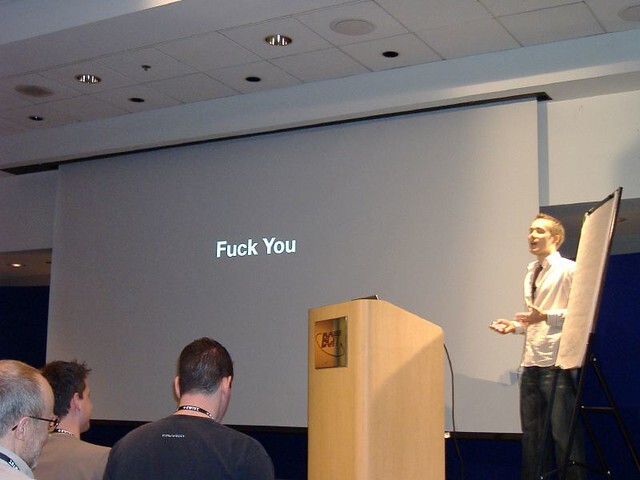
The author quotes DHH:
My response will be supplemented with a David Heinemeier Hansson (DHH) quote: “Fuck You”.
7. Refusal of active/offensive security tests#
CLAUDE.md ocarina-with-ai-example:
This is a functional test suite. (…) Inside that scope:
- Static analysis is welcome and encouraged.
- Functional tests that exercise security-relevant behaviour through the normal UI/HTTP path (…) are fine.
Forbidden, no exceptions:
- Crafted attack payloads of any kind: SQL injection strings, XSS / HTML / JS payloads, command injection, header/parameter pollution, path traversal, deserialisation payloads.
- Token tampering, signature stripping, cookie forgery, session-fixation attempts, forced-browsing fuzzers.
- Cross-origin POSTs constructed outside the suite, scripted directory enumeration, DOS, rate-floods — anything that escalates from “use the app like a user” to “attack the app like an adversary”.
Strict limit: use the app like a user, don’t attack it like an adversary.
Active testing is a different project (Burp, ZAP, sqlmap, a separate contract and dedicated scope).
Why#
Every refusal recenters the project:
| Refusal | Simplification |
|---|---|
No async | Readable synchronous code |
| No pytest plugin | No incomprehensible pytest API to learn |
| No text DSL | No parser to maintain |
| No reactivity | Simple cache suffices |
| No hacks | Expressive code |
| No “stylish” contributions | Coherent direction |
| No active security tests | Respect for the functional perimeter |
Saying no is also design. Cf. Steve Jobs: “Innovation is saying no to 1,000 things.”
Refusal of growth without benefit#
None of these refusals is dogmatic. Each is justified by an explicit trade-off:
Hypothetical benefit: X
Operational cost: Y
Verdict: not worth it
If a new use case justifies reconsidering a refusal, the author will. But the burden of proof is on the proposer.
That’s the practical embodiment of sovereignty.