
First feedbacks
From the start, Ocarina was quietly introduced to professionals across the field, from all backgrounds.
First grievances
The first "criticisms" were often the same: "You're bragging about something that's very simple."
Some stopped there.
Others went further: trying to explain what "real complexity" is, in their view.
But none of them would have been able to achieve the same thing.
The funniest part is that I didn't even have to bring up complexity myself. I just presented some test scenarios written with Ocarina, and that reaction came up immediately.
It's just the result of the operant conditioning of 99% of the folks in our industry.
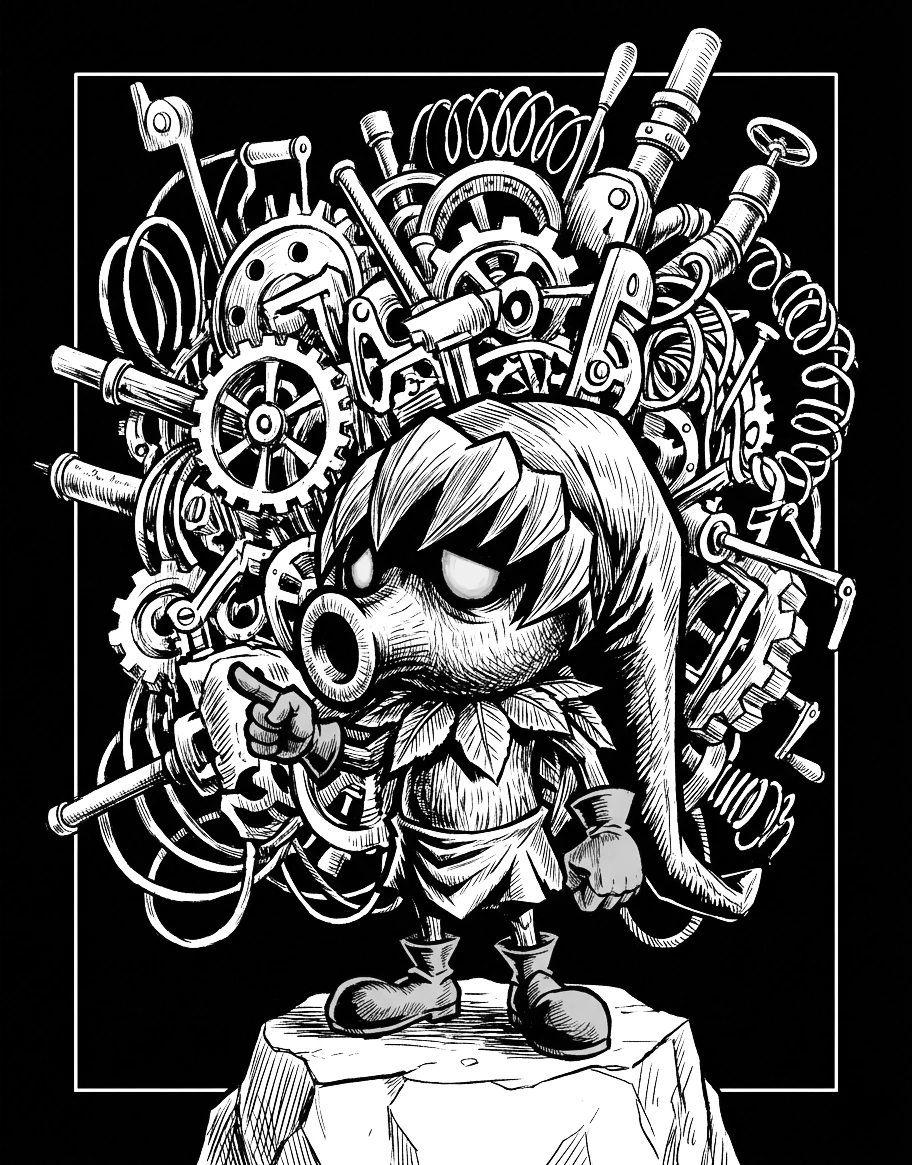
Adding yet another cog to an incomprehensible machine seems to be the fetish of many Mojo engineers.
For them, opening the hood was enough.
First things first: this is not about bragging.
Ocarina is not the product of showmanship, unlike what many "engineers" tend to produce. It is simply the product of what emerges naturally.
Narcissism expresses itself through making everything shamefully complicated for the sole purpose of domination. Not through acquiring skills and simplifying processes, since the end result is total malfunction: chaos.
This is also one of the ways you can quickly spot narcissists in a casino: the more a machine flashes, the more "complicated" it seems, the more a narcissist will want to sit down and prove they are "smarter than the machine."
They can also be recognized by their intolerance of failure. They systematically want to show how much THEY have "thought of everything."
Never any red with a narcissist, only green, only "ready to ship to production."
The consequences are dire, on top of being radically opposed to the mindset of software testing: narcissism brings nothing good in this domain.
In any case, it brings absolutely nothing good anywhere: it brings nothing but hell on earth.
Ocarina is radically opposed to these phenomena.
Performative complexity
Real complexity doesn't show off. It is felt. In stability, in extensibility, in what doesn't break.
There is no added value in building something horrendously complicated to use, other than proving that it's complicated. Nobody asks for that.
Our industry has a serious problem with complexity being treated as a badge of seriousness.
This complexity exists solely to "impress peers," and achieves nothing but outdoing oneself in stupidity.
Excelling in the wrong direction is worse than plain mediocrity and that is the only "achievement" to see in it: congratulations, you have successfully reached the top of the pyramid of bullshit where no self-questioning exists anymore!
This is also why KISS (Keep it simple, stupid) is so misunderstood in the industry. Many assume "simple" means "unsophisticated." It would be hard to misread a principle more thoroughly.
So we end up with the worst of both worlds.
How can one claim to be productive in this way? Seriously?
You. Don't. Even. Know. What. "Clean code". Actually. IS.
You didn't even try it!
Philosophy
KISS
KISS is at the heart of Ocarina.
And if, upon reading a first test scenario, the reaction is "this is super simple..." it would be a shame to mean it as criticism: that is exactly the compliment being sought.
Thank you.
To get there, the question was never about "shining" brighter than anyone else.
That was never really a challenge to begin with.
The question was simply: what do I actually need?
Some folks had other ideas, quite "creative" ones at that:
- Twisting Ocarina's ROP (Railway Oriented Programming) implementation until it lost all meaning, since they didn't even know what ROP is,
- Dropping "hooks" and other so-called "ninja techniques" right in the middle of test steps,
- Abandoning typing,
- Rewriting in Rust over "performance" concerns,
- Forcing their clueless take on lazy evaluation and IoC down my throat like it's gospel,
- "Explaining" imperative vs. declarative programming to me while spewing complete nonsense,
- "Talking" to me about event-driven programming, while still spouting nonsense,
- And worst of all, pontificating about a horrifying theory of "declarative object-oriented programming,"
- Etc.
Even someone I had a great deal of respect for until then started getting on my nerves.
He thought he had things to teach me, acting arrogant, telling me "what was missing" in a disagreeable tone, when everything he was talking about was not only on the roadmap, albeit still deliberately hidden for strategic reasons, but would go far beyond anything he could ever imagine.
Me, I said nothing, I stayed silent after sending the repo.
Him, immediately, he "knew everything" better than everyone else.
What's being "disruptive"
Well, right now I'm doing YC and my client is IBM.
Yeah and I know the Queen of England.
Have I ever told you about the yakuza?
I went to a top engineering school and since then I've learned nothing new.
Sure: let me quote the motto of the first Indonesian hacker crew I was exposed to as a child: "We Can Do All What You Can't Do."
I'm the bug you can't kill.
And I am not here for the prestige. Nor even for the profit.
I am here for our community.
In the Lulzboat, salute, bitch, and show some respect.
YOU, you would have been that lamer, that kid who just wanted to show off and launched Exploit-DB PoCs from his bedroom like a rookie. To prove yourself, to put yourself on display, to make us see just how in you are. ME, I'm that kid who absorbed everything, and grew up with it.
Fucking skids.
Fucking normies!
Here's who we are: from Zone-H to respectable life.
From the underground sewers of the internet to a life where one manages to be quietly useful.
You would never have survived things like that.
From Hell to where we are today.
Saved by Research, by beautiful values, by thankless work. Not the kind that makes you shine. The kind passed on by those who know how to detect potential and save it before it's too late.
NOBODY saved us, we saved OURSELVES.
Thanks to what SCIENCE says.
We could have been bloodthirsty, instead we became skill-thirsty. We are people who have dedicated their lives to these screens, to this science, while you were bullying teenagers in Dota chats or doing god knows what, always showing off, always proving you're the most handsome, the strongest, the smartest, the most overbearing.
We, we are retarded, but we will stay online until the very end!
We are a true FAMILY!
And we are SLEEPLESS!
"It's completely autistic."
"You'll never amount to anything."
"You're crazy."
"What you're doing is completely stupid."
"Actually, what you write makes no sense whatsoever."
(btw: RIP, DG descendant...)
YOU'RE GOING TO BE REPLACED AND YOU'LL GO BACK TO HARASSING YOUR PEERS ON DOTA AND JERKING OFF TO VBA MACROS LIKE THE PIECE OF SHIT YOU ARE!
YOU FUCKING INCOMPETENT ASSHOLE!
YOU FUCKING PARASITE!
YOU FUCKING INCAPABLE!
YOU FUCKED WITH US!
Incorruptible
Moreover, my answer will be followed by a quote from David Heinemeier Hansson (DHH): "Fuck You."
Yeah. Exactly: Fuck You. That's all.
I have NO INTEREST in programming that "way," and I OWN Ocarina.
Sharing Ocarina means sharing a car I have maintained entirely myself, for myself, therefore with great care. Still, it is shared as-is, and will remain so.
It's my car.
I channeled all my anger into it, to pour all my love into it.
Ocarina has a direction.
Those who wish to take it elsewhere with their wishful thinking are free to fork it and never contact me.
Contributing to an open source project because it's "cool" is a completely immature mindset, and tolerating this phenomenon causes real damage.
No genuine contributor does it for "fun" but out of alignment of self-interests.
Ocarina is not and will never be a pontificating solution.
Ocarina is and WILL REMAIN a solution for solving real-world issues.
If you disagree, get back to r/unixporn, where you belong. ✈️
First relevant interaction
A professional who had actually looked at the project structure reacted: "This looks like one of my old Selenium projects and I hated that." That's exactly the kind of feedback Ocarina is built to address.
His first instinct was to equate POM with Selenium. Fair enough.
But POM works with any automation technology.
Is it "old school"? Absolutely. And? What's next?
Walking through his frustrations, he found out how Ocarina handles them: "Wait, that's it?"
But, this time, with a nod of respect. He admitted it was time to stop trying to be the cleverest guy in the room. Past a certain point, that's what kills a project.
The TRUE solidarity
Instead of going nerdy, Ocarina focuses on solving small problems without creating bigger ones.
The conclusion drawn from this is: "Ocarina is practical."
This is the purpose of Ocarina: its practicality.
This is how we work and that's really all it takes to get on board with Ocarina's philosophy.
No need to be a hacker, no need to have suffered so much.
It's a tool we offer, for the passionate ones, the truly passionate ones.
For those who want to build, not destroy.
For grounded, cultured people who know who they are.
For people like us, after all.
For once, let's unite.
Far from those who pillaged what we were.
Why not Playwright?
His follow-up: "Why not Playwright?"
Fair point.
Ocarina is agnostic, so wiring Playwright is easy.
The only constraint: Ocarina will never support async/await.
Better still: since Ocarina 1.1.3, there's nothing left to wire by hand. A first-class Playwright adapter ships with the framework, and a worked example is there to prove it.
Secession
Today, people launch projects the way you'd pop out to buy a pack of cigarettes.
They try, because it's "trendy." So, they all copy each other, take out subscriptions to each other's products just to mutually inflate their numbers and deflate each other's Stripe dispute rate.
They think they're smart, but: the reality is that every VC and every LP is well aware of it, and each plays their part in a fool's game.
But there is something they will never understand. They have nothing "underground" about them: they are merely kids in an identity crisis. Children who were gently handed Powerpoint in exchange for their crayons.
A lesson for these amateurs: any truly "cutting-edge" project, whatever it may be, starts from a pamphlet, is rooted in identity, and goes through a stage of genuine anti-marketing. But since you're all afraid of embarrassing your mother, you never go through it.
As for me, I have nothing to lose in terms of reputation, there is no reputation to build under this name. Only a message to deliver, as it is, unfiltered.
It's time to kick all your Juicero Presses in the ass.
With that knowing smile, the one of those who finally have what it takes to say STOP.
IT is what brought the smile back to our lives, not what persecuted us through pseudo-"patterns" each more idiotic and inaccessible than the last.
You thought computer science was going to die?
Far from it.
Anti No-Code
Code is raw data. Auditable. Inspectable. A white box.
Exactly what AI has known how to work with since its very beginnings.
In our own silos, we'd already had a taste of this, even before IntelliCode (2018). As far back as 2013 on our end: a private Emacs (damn) plugin built by one of our mad scientists, R. Nobody could grasp his level in reverse engineering, nor his conciseness. Likewise in other areas... truth be told, he was bad at nothing, and had an extraordinary ability to always write exactly what needed to be written.
End of a myth: he had his own AI autocomplete and auto-review. 2013.
He would reject most of the generated code, but said this: "I don't mind deleting 15,000 lines if it saves me from writing 1,000 myself."
By 2013, the game was no longer about being mindless "coding" apes.
It was about cultivating yourself to understand how a machine inspired by our own reasoning would help us rise above all that nauseating, doomed-to-die OOP.
But "savant" OOP won't be the first or the last casualty.
Computing evolves mostly in one direction: who would freely choose to use Windows 95 today?
And yet, λ-calculus (1930) is so powerful it's back in the spotlight today, just like AI (first formalization of the artificial neuron in 1943, McCulloch & Pitts).
Extraordinary in the history of IT.
The latest advances in AI have reshuffled the deck for SaaS, which exists only to hide complexity. Genuinely useful SaaS products, not the endless aggregators of this pompous "digital transformation," are always on the right side of History. However ugly they may be.
Companies from the Prisma or Vercel ecosystem spend ~$200 in tokens per vendor they drop. A weekend of vibe coding, and they wave goodbye to bloated, overpriced, sluggish SaaS platforms, in favor of internal development and a return to raw data.
December 2025: Lee Robinson, ex-Vercel, a familiar face from recent Next.js and Turborepo presentations among others, announces he's ditching Sanity, Cursor's CMS choice until then. In favor of a return to raw data, to simple Markdown files. A few tokens, some well-executed vibe coding. Thank you, goodbye.
Code is Law. Code substitutes for Law. Lessig, 1999, as a warning cry.
Then reclaimed by Ethereum in 2015, inversely, as a political ideal. A meaningful step forward, in a world of currency minted from factoring digits.
Anti devs
2016: the hack of The DAO, a decentralized investment fund on $ETH.
Why?
Bugs. Damned bugs, caused by damned devs.
An ideological regression of almost 20 years. The counter-power had made the lazy choice of "not understanding," the same choice that allowed a bunch of incompetents to slip under the radar.
And yet it's simple: unlike Researchers, engineers and their business school friends rely on wishful thinking.
The most "prestigious" schools taught them one thing: passing off hot air as "engineering," while those who actually know what they're doing call it programming astrology.
Anti startup nations
And once again, the gray-haired debate about "democratic governance of code."
But who is stepping in?
HR people?
CEOs?
Presales reps?
2022: ChatGPT. Yet three years later, startup founders are still selling No-Code "enhanced by AI." Pure cash burn chasing a market anomaly, nothing more. Investors' alpha... in other words: their casino.
Don't name anyone, especially since their results are expected in Q2 2026.
Just say that on the basis of fundamental analysis, this bet makes no sense. That said, there's no need to wish them ill. It wouldn't be the first company we've seen fail miserably, nor the last we'd see succeed to everyone's surprise.
The fact remains that code is the most sovereign asset we have, and a value proposition centered on taking it away from us makes us hold our nose. The real problem is the devs we let bang on their keyboards without knowing what they're doing, like trained monkeys. Today Claude Code outperforms 99% of them, and they're howling. The dogs bark, the caravan moves on.
The true human value-add has never been more clearly identified: taste and sense of responsibility, qualities conspicuously absent in these "professionals" who drown us in entire "ideologies," just like those who sell what they don't understand.
Anti hype
That same December 2025, the startup whose name shall go unspoken was featured in certain media outlets as "the AI No-Code test that humiliates Selenium and has BrowserStack shaking." No less. Good luck to them: entrepreneurship is a world of bets and randomness, where the best ideas end up in the graveyard just as often as the most outlandish ones. Fundamental analysis gets beaten there regularly.
None of this, however, will steer Ocarina away from a vision that has been taking shape for over 15 years, far from the arrogance of all these children of the hype.
Whatever happens, we still wish them a fate that spares them from a humiliation as swift and spectacular as the one suffered by the founder of Cluely and we invite them to reconsider their arrogance.
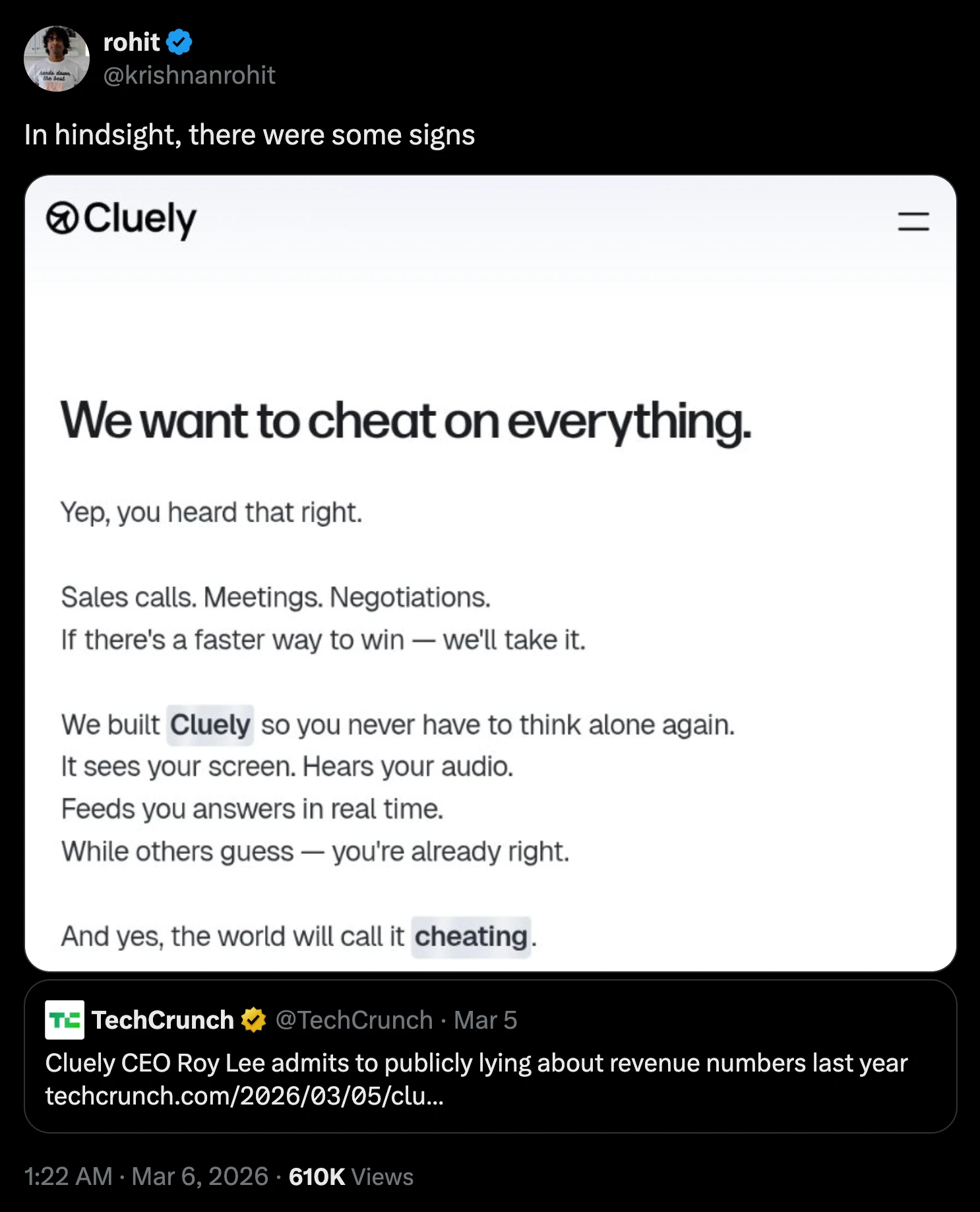
Cluely CEO Roy Lee admits to publicly lying about revenue numbers last year. Then, Krishnan Rohit outlines that their value proposition was fraud since the beginning.
Today, the challenge of being the biggest scammer is becoming less and less profitable.
And we are glad of it. Once again, with AI, that sorely missing digital body, let us scream it, as loud as we screamed "HACK THE PLANET" back in '99: CODE IS LAW.
Anti slipologists
For too long, software has been held hostage by a minority, a "1%" who saw fit to turn it into a playground for the initiated: "geek tricks," "ninja techniques," "object-oriented." The verdict is clear: it doesn't hold up, or barely does.
What has been on our minds since the 1930s, since the invention of λ-calculus, is finally scalable to the degree we always wanted it to be.
Has our industry ever witnessed such an elegant formalization, one so deeply rooted in its own heritage?
The recent evolution of Python's type system is central to what makes Ocarina possible.
Without being "the future" either: this is established science, but one that arrived cruelly late in our ecosystem.
As does AI, which is quietly rendering the "1%"'s capacity for harm obsolete.
The gratitude owed to these technological advances is as immense as the rage of those who rail against them, whom we fondly refer to in our parts as slipologists.
See also: Haters, by Paul Graham.
For all these reasons, I have made the decision to NEVER waste my time arguing when it's not worth it. I enjoy arguing with people focused on problem-solving and who have good judgment.
For the rest: make pointless PRs red and pointless issues gray, no regret.
Some people are simply not meant to please me, but so be it.
Ocarina is the first of my projects that I'm opening to the public, but others are also on the way, including some far more interesting ones.
From the underground,
For Now and Forever.
"An idiot admires complexity, a genius admires simplicity, a physicist tries to make it simple. For an idiot anything the more complicated it is the more he will admire it, if you make something so clusterfucked he can't understand it he's gonna think you're a god cause you made it so complicated nobody can understand it. That's how they write journals in Academics: they try to make it so complicated people think you're a genius."
"To attain knowledge, add things every day. To attain wisdom, remove things every day."
Игорь Казанова
Hacking from Bastia to Moscow